Showing posts with label outdoors. Show all posts

Saturday, March 1, 2014

looking closely at snow and ice

I asked Jenna Loewen's Grade 1 students at Garden City what they had noticed about snow during the week. We don't get snow very often so the students were excited to tell me about making snowballs, forts, snowmen and snow angels. When I asked them more specifically about that they had noticed about the snow, they commented that it was white and cold.
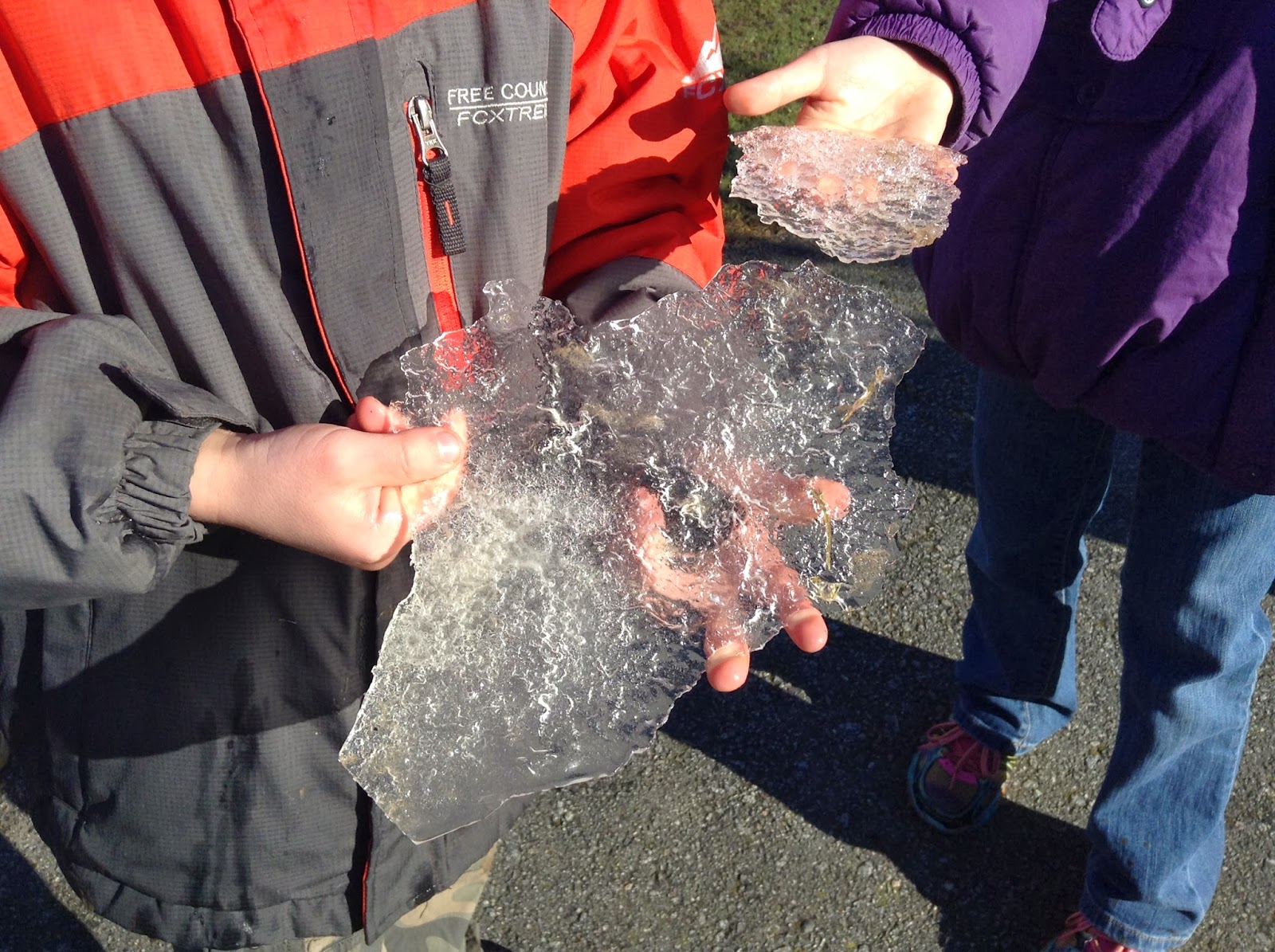
We ventured outside to look closely at what remained of our big snowfall. Most of the snow had melted by Friday but we were still able to find patches of snow which made for interesting questions as to why some snow hadn't melted yet.

I brought along a tub of magnifying glasses and loupes to help focus the students and take some time to actually look at the snow in some detail. I also had my olloclip macro lens ready to get some "zoomed in" photos. The students were also excited to find lots of ice outside.


Some students found some animal tracks in the snow and we looked across the field to find the likely matches - mallard ducks!

The students brought some ice back into the classroom and we used the zoom usb microscope to look closely at the ice. The zoomy magnifies things up to 43X so we got some really close looks at ice.


After looking closely at the snow and ice, we asked the students to share their observations and choose words to describe what they noticed...their descriptions had grown significantly from "white and cold" to: sparkly, watery, curly, shiny, crystals, golden, silver and the ice had smooth edges.

The students made some connections to some crystals they grew in their classroom:

With snow in the forecast again, maybe these students will get another chance to look closely at snow and see it from a new perspective.
~Janice

Sunday, February 9, 2014

Primary Scientists: looking closely at our practice

A large group of primary teachers in our district are taking part in the third year of Primary Scientists, a professional learning series focusing on process-based science and initially created as an implementation series to support the development of the Coast Metro Science Performance Standards. Teachers are all engaging in looking closely at one aspect of their practice in terms of science teaching and learning with an overall group focus of thinking about how we assess process and inquiry-based science experiences.

Using the science performance standards and assessment tools from the current K-7 Science IRP and the teacher resource book we are using for this series, teachers are asked to try different ways of assessing science performance tasks.

Teachers have chosen different aspects of science to focus on this year as part of their own inquiries into their professional practice: taking learning outdoors, looking closely (a national collaborative project), the processes of science, observational drawing and place-based learning using indigenous knowledge.

Based on the Looking Closely books by Frank Serafini, several of the teachers created their own versions of the books with their students. With her grade one class at Garden City, Jenna Loewen created a class book using garden photographs and having the students brainstorm what they could be.

April Chan at Blair took her students outside to look closely and create a peekaboo page with a hole cut out on the front page to take a peek at the illustration the students did of something they observed.


Sharon Baldrey and Kathleen Ellis from Lee Elementary looked closely at ice with their kindergarten classes. After freezing blue-dyed water into globes of ice, the students used salt and flashlights to investigate the properties of ice and how it melts. The teachers commented on how engaged the students were and what great inquiry questions came up during their investigations. Amazing photos of an amazing experience!


Louesa Byrne's K/1 class at Thompson looked closely at leaves in the fall and inspired by Ann Pelo's book, The Language of Art, observed and represented the leaves in using multiple forms of art materials - liquid watercolours, crayon rubbings, technical drawings with fine line markers and creating leaf forms with wire.


April Chan at Blair did a similar focused study of leaves with a small group of primary students. The students used the PicCollage app on the iPads to document the different ways they created representations of their leaves.
So as we engage our students in looking closely at the world around them, we too are looking closely at student learning in science.
-Janice

Saturday, January 18, 2014

collaborative science inquiry at Blair

The primary teachers at Blair are taking part in a collaborative inquiry project looking at ways of moving science outdoors as well as ways of documenting science learning in science notebooks.
On Tuesday, I met with the teachers at lunch and then spent time in two classes in the afternoon.

In Tanyia Kusch's grades 2 and 3 class, the students have just begun learning about structures. The students could tell me what they had read about natural and human-made structures so we went for a short walk outside to notice some of these structures and to think about the question, What are structures?

The students then came back into their classroom to draw and label the structures they had seen outside, using their science journals.


As students were recording the structures in their journals, one student wondered, 
"Are people structures?"


The students enjoyed building structures using materials they found in the classroom. We had lots of portables, houses and a tree.


And a little animoto video:


In Karen Sato's grade 1 class, Karen started the class by reading Questions, Questions by Marcus Pfister to inspire the students to ask questions and wonder when we went for a walk outside. We walked around the school park looking for signs of winter.
The students found lots of mud, lots of moss and grass (such a mild winter we are having!) and some branches that had fallen to the ground during the latest storm.


We also found a large deciduous tree with an empty bird nest in. The students had lots of questions about the nest.

Why do birds live in nests?
Why is the tree bare?
How do they make nests?
Why are they are camouflaged?
Why do they make them with sticks?
Why do they only make nests in trees?
How does the nest balance on the tree?

We'll have to re-visit the tree in the spring and see if we see anything new!

~Janice